
Author: Rodrigo Ronda
In any collaborative system—whether project management software, workflow platforms, or customer support tools—clarity of responsibility is essential. When users are unsure of who needs to act next, tasks stall, accountability is blurred, and frustration builds. A simple yet powerful interaction design solution to this problem is what we call “Ball In Court,” or “BIC” for short.
The Concept
The metaphor of “ball in court” comes from sports, where the ball’s position indicates whose turn it is to act. Translated into digital systems, the Ball In Court clearly indicates when a user is responsible for the next action. Instead of sifting through long lists, ambiguous notifications, or hidden dependencies, users immediately see when the “ball” is in their court.
The Origin and Meaning of “Ball in Court”
The phrase “the ball is in your court” comes from the world of sports, particularly tennis, badminton, and similar games played across a net. In these games, the court is divided, and when the ball lands on your side, it is your turn and your responsibility to act. If you fail to return the ball, the play ends, and the responsibility is visibly yours.
Over time, this sports term evolved into a common idiom in English, used in business, law, and everyday communication. When someone says, “The ball is in your court,” it means:
-
Responsibility has shifted to you—you are the next person expected to take action.
-
The system or process cannot move forward until you respond, decide, or contribute.
-
Agency and accountability are clear—everyone knows who is responsible at this moment.
Because the phrase is widely recognized and intuitive, it serves as an effective metaphor for digital systems that need to signal responsibility.
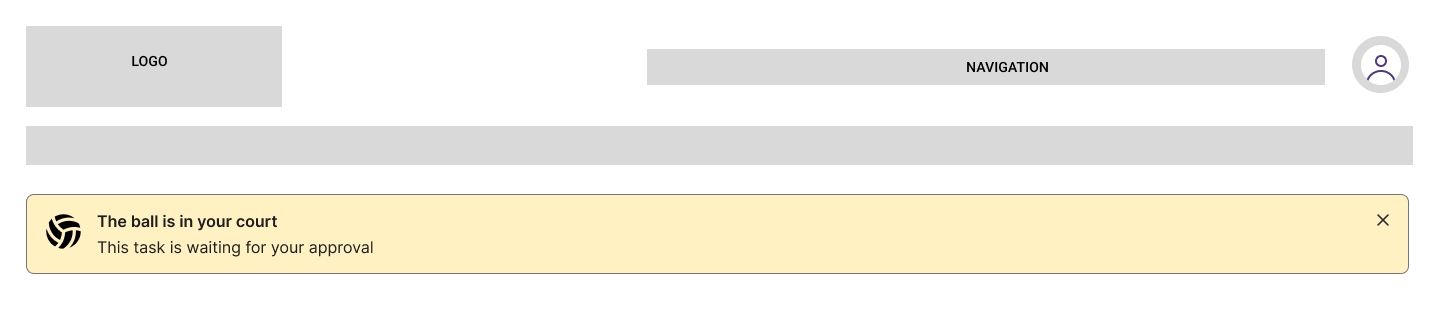 The Design Solution
At the heart of this approach is a visual marker:
-
An icon of a ball placed inside an alert element (such as a badge, highlight, or notification frame).
-
This icon appears next to items that require the user’s attention or decision. For example, a badge or a chip.
-
By combining a familiar metaphor with a distinct visual, users can quickly identify their responsibilities at a glance.
The simplicity of the design makes it highly flexible—it can be applied in dashboards, task lists, approval workflows, or even messaging systems.
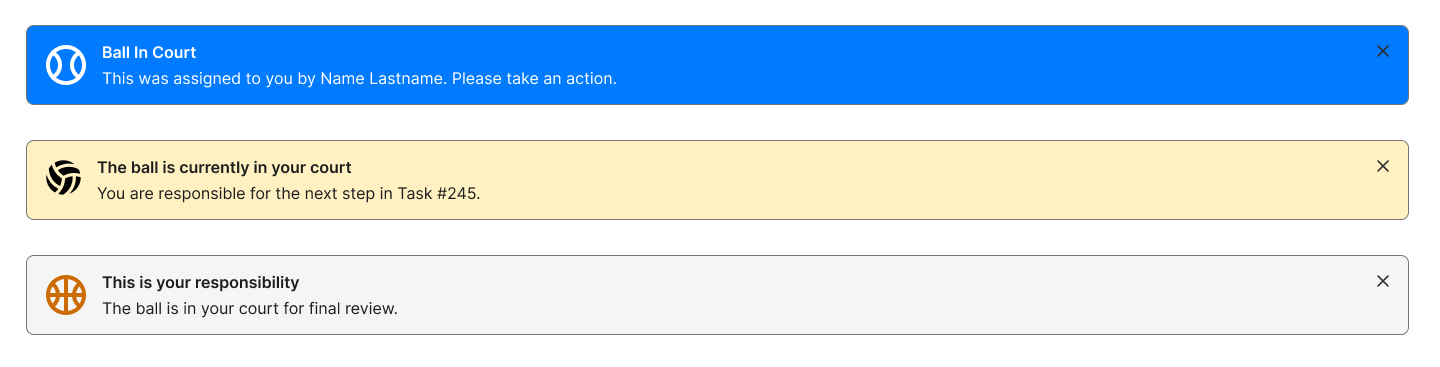 Why It Works
-
Metaphor Alignment
The sports metaphor is widely understood. Most users intuitively grasp that when the ball is in their court, they need to act. -
Visual Salience
The ball-in-alert icon creates immediate recognition, cutting through cognitive load and helping users prioritize without reading lengthy descriptions. -
Accountability and Flow
With clearer cues, teams reduce delays and confusion. Users feel more confident knowing exactly when responsibility shifts to them. -
Scalable Across Systems
The representation can be embedded in different modules—approvals, pending tasks, escalations—without requiring users to learn new symbols for each context.
Interaction in Practice
Imagine a workflow system for processing contracts:
-
A user submits a draft → responsibility passes to a reviewer.
-
The reviewer receives a “ball in court” marker next to the pending contract.
-
Once the reviewer approves, the ball shifts to the next role in the chain.
At every stage, the system transparently communicates who holds the ball, eliminating uncertainty and helping the process flow smoothly.

The BIC could be shown using a widget or a chip.
Examples of messages to use
Here are some examples of messages you can use:
General Workflow
-
“The ball is in your court — this task is waiting for your approval.”
-
“Action required: You need to review this item.”
-
“Your turn: Complete your part to keep the process moving.”
-
“Pending response: The ball is currently in your court.”
Project Management
-
“You are responsible for the next step in Task #245.”
-
“Milestone blocked: The ball is in your court for final review.”
-
“This issue won’t move forward until you take action.”
-
“Project progress depends on your update — ball in court.”
Customer Support / Ticketing
-
“Ticket #823 is waiting for your response — ball in court.”
-
“Client is waiting: Please reply to proceed.”
-
“Your action is required to resolve this request.”
-
“Next step is yours — ball in court for support ticket #502.”
Approval / Decision-Making Systems
-
“Approval required: Ball in your court.”
-
“Decision pending: Please confirm or reject this request.”
-
“The workflow is paused until you respond.”
-
“Next step: Review and approve before it continues.”
Friendly / Motivational Tone
-
“It’s your move! The ball is in your court.”
-
“Tag — you’re it! Time to take the next step.”
-
“We’re waiting on you to keep things rolling.”
-
“Ball in court — time to shine!”
Broader Implications
Ball In Court Representation is more than just an icon—it’s a design pattern that embodies clarity, accountability, and user trust. By making responsibility visible, systems respect the user’s time and reduce friction in collaboration.
When responsibility is hidden, systems foster confusion. When responsibility is visible, systems foster action. The ball in court metaphor gives us a universally understandable way to make responsibility transparent.